Development
Devlog-9: Hybrid Onboarding, Smarter Quest Management, and a More Social Universe
April 20, 2026 / Orion's Gate Team
This week's development cycle has been one of the clearest signs yet of where the game is heading. While we have always believed in the strength of Web3-native systems, we have also been carefully preparing something we have hinted at for a while: a hybrid player experience. Alongside that, we pushed major progress on referrals, quest usability, map development, and notifications. Each of these updates helps move the game closer to a more accessible, scalable, and player-friendly experience. Here is what we achieved in this cycle.
Hybrid Onboarding Is Taking Shape
One of the biggest developments this week is our progress on Web2 onboarding and registration integration.
From the start, we successfully built and completed 100% Web3 on-chain actions. That foundation remains a major part of our vision. But as development continued, it became increasingly clear that if we want to support stronger mobile gameplay engagement and lower the barrier to entry for a broader player base, we also need a more flexible onboarding flow.
That is where the hybrid system comes in.
We are currently integrating Web2 onboarding features alongside our Web3 systems, allowing players to enter the experience more smoothly while still preserving the deeper blockchain-powered mechanics that define the project. This is not a compromise in vision. It is a practical step toward better usability, better retention, and a more scalable live product.
At the moment, roughly 90% of this development is complete, and the system is now near production-ready.
This is one of the most important shifts we have made so far because it aligns with something we have always believed: technology should support the player experience, not stand in its way.
Referral Links Are Now Live in Settings
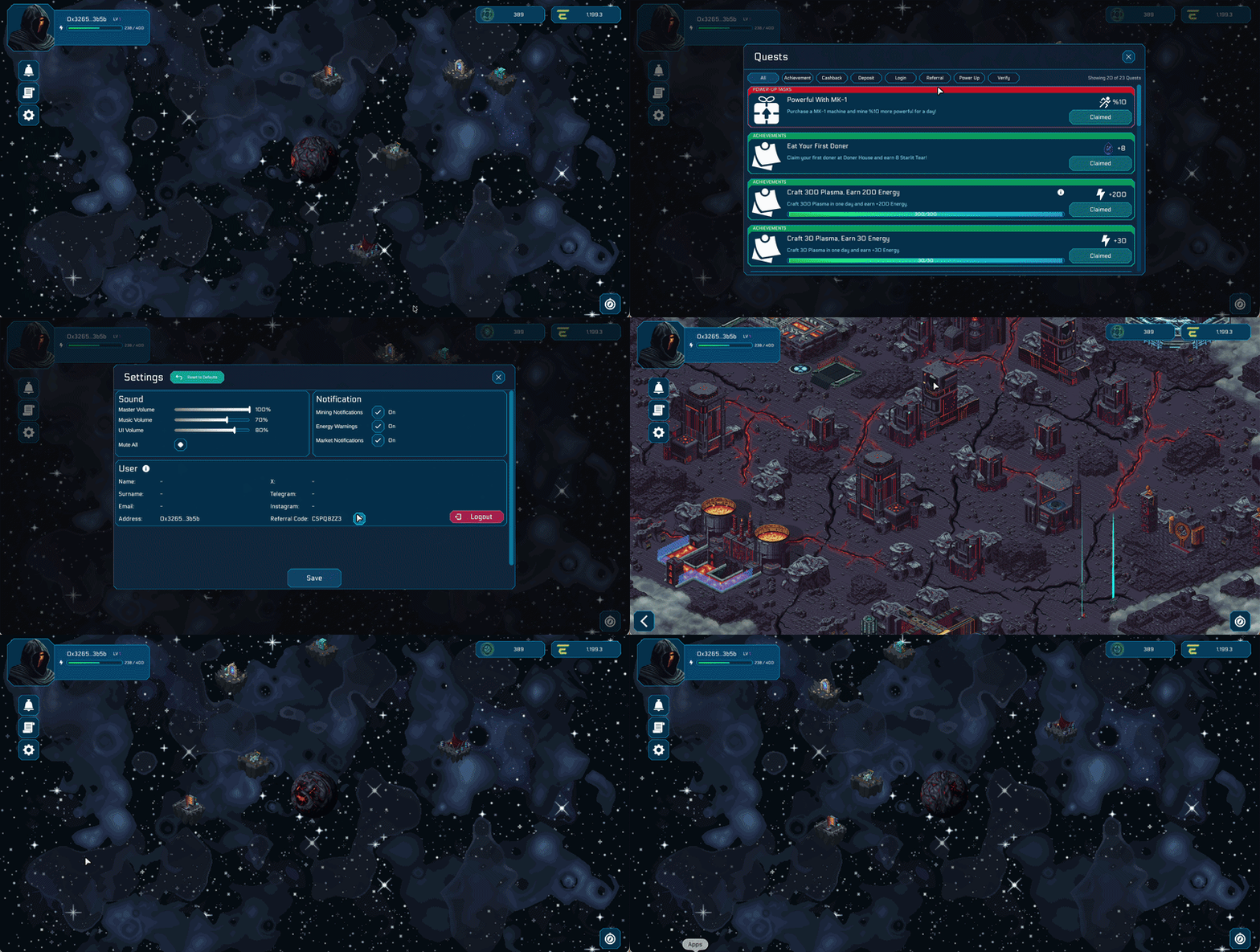
We have also introduced a referral link feature directly inside the settings page.
Players can now track how many people they have invited into the game and begin building their own early communities around the experience. While the current feature already adds a meaningful social layer, it is also connected to a broader direction we have in mind for future development.
Community growth is one of the most powerful parts of any live game. By giving players visibility into their invitations and network growth, we are beginning to lay the groundwork for a more community-driven ecosystem.
Right now, this feature works as a practical tool. Over time, it may evolve into something much more impactful.
Space and Planetary Maps Have Been Reworked
This cycle also included a major push on space and planetary map updates, which involved a substantial game asset development process.
Visual worldbuilding is one of the most important parts of how players connect with the game. Because of that, we revisited both map structures and design direction to make sure the environment better supports the kind of experience we want to deliver.
The planetary map is still in active development, particularly because of ongoing work on particle animations, but we made the decision to move forward confidently with the new map design concept rather than delay the broader visual direction.
That means the foundation is set. The concept is locked. Now the focus is on polishing the environmental motion and atmosphere that will bring the map fully to life.
This is a major step because it gives the world a stronger identity while also helping us better define how players move through and emotionally read the environment.
Quest Subgrouping Improves Usability
We also added subgrouping for quests.
This is one of those features that might sound simple from the outside, but it makes a huge difference in how players manage their progression. Instead of viewing all ongoing quests in one flat structure, players can now organize them in subgroups, making it easier to track objectives, manage active tasks, and collect rewards more clearly.
As the game continues to grow, progression systems naturally become more layered. Features like subgrouping help keep complexity from turning into clutter.
This update improves clarity, reduces friction, and makes the quest experience feel more controlled and rewarding.
Notification System Is Fully Working
Another major milestone from this cycle is that the notification system is now fully working.
We previously introduced the feature, but this week was about making sure it truly reached the quality bar we wanted. We cleared the remaining bugs, fixed version-specific issues, and now have a stable notification flow in place.
This means players can rely on notifications as a consistent part of the gameplay experience, rather than as a partially implemented support system.
For us, this matters because notifications are not just UI extras. They are part of how the game communicates with the player. A stable notification system improves flow, responsiveness, and overall clarity.
It is one more feature that helps the entire experience feel more alive.
What We Are Working on Next
While this cycle delivered major progress, the next phase is already underway.
Community Chat System
We are currently working on a community chat system that will support both public and private messaging. This is an exciting step for the social side of the game, especially because we are looking forward to integrating it into the Intergalactic Döner House.
That space has always had strong community potential, and adding live communication will help turn it into an even more meaningful social hub.
Completing Web2 Onboarding
The hybrid onboarding system is close to done, and now the focus is on the final stretch. We have completed a large portion of the development and are getting ready to push this feature to production.
Particle Animation for the Main Planetary Map
The visual concept for the planetary map is moving forward, and the next major step is adding particle animation. This will help create a more dynamic atmosphere and strengthen the visual identity of the environment.
Alternative Payment System for the Marketplace
We are also starting work on an alternative payment system for the marketplace. This is a new direction and an important one. Just like hybrid onboarding, this reflects our broader approach: making the experience more accessible without losing the systems that make the game unique.
Closing Thoughts
Devlog #9 is really about one core idea: expansion through usability.
We are not moving away from our Web3 roots. In fact, our on-chain systems remain fully developed and central to the project. But we are building smarter access points around them so more players can actually enjoy the world we are creating.
Hybrid onboarding, referrals, quest subgrouping, map redesigns, and a fully fixed notification system all point in the same direction: a game that is becoming more polished, more social, and more ready for real players.
And with community chat, marketplace payment alternatives, and production-ready onboarding on the horizon, that direction is only getting stronger.