
Industry Insights
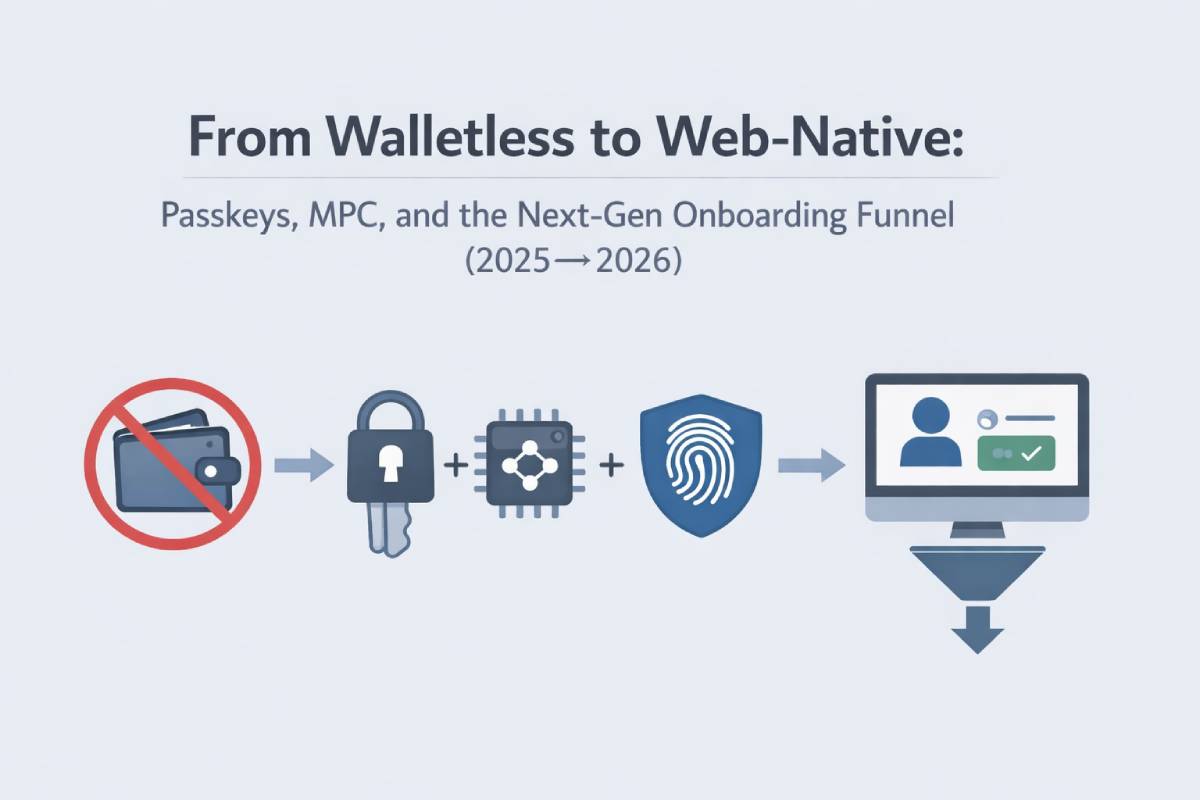
From Walletless to Web-Native: Passkeys, MPC, and the Next-Gen Onboarding Funnel (2025→2026)
January 27, 2026 / Orion's Gate Team
The fastest-growing funnel in web3 ditches seed phrases and browser extensions. Passkeys (WebAuthn/FIDO2) remove password friction, MPC eliminates single-key risk, and account abstraction (ERC-4337) turns sign-ups into sessions that feel web2-fast—complete with gasless actions and session keys for uninterrupted play. Put together, this “web-native” stack lifts conversions from click → install → first on-chain action. [1][2][3][4][5][6][7][8][9]
Why this matters now
Consumer signals say the passwordless shift is real: FIDO's 2025 reports show growing passkey familiarity and usage across major markets; nearly half of the top 100 websites now offer passkey login, more than doubling since 2022. Google and Microsoft also report big spikes in passkey usage and daily registrations. [1][10][11] Governments are leaning in (e.g., Germany's BSI guidance), while major platforms (Microsoft Authenticator) are de-emphasizing passwords entirely. [12][13]
For crypto, this unlocks seedless onboarding: wallets like Coinbase Smart Wallet lean on passkeys and cloud backup for recovery, bringing mainstream users in without the “write 24 words” cliff. [14][15]
The new stack (and how it fits together)
1) Passkeys (WebAuthn/FIDO2)
What: Phishing-resistant sign-in using device biometrics; credentials are scoped per app/site. [6][11]
Why it converts: Fewer failed logins, no password resets, and seamless multi-device sync. Dashlane reported +70% higher successful sign-ins vs. passwords; Google logged 1B+ uses by mid-2024. [10]
2) MPC (Multi-Party Computation) wallets
What: A private key is split into cryptographic shares across device/servers; no single point of compromise. Appears on-chain as a normal signature. [7]
Why it converts: Recovery without seed phrases; optional “guardian” flows; compatible with OAuth/passkey sign-ins. Popular SDKs (e.g., Web3Auth MPC Core) pair passkeys with MPC shares for seedless self-custody. [16][17]
3) Account Abstraction (ERC-4337)
What: Smart accounts, UserOperations, Bundlers, and Paymasters enable gasless, batched, and policy-aware transactions-no pop-up spam, no “what is gas?” hurdle. [8][9][18]
Why it converts: You can gate the whole tutorial behind a single signed session and sponsor fees until a player is hooked.
4) Session keys for uninterrupted play
What: Time-/scope-limited keys that let the app sign specific actions without re-prompting the user (think: “play for 30 minutes” or “craft up to X resources”). Big in on-chain games (Starknet's Cartridge, Argent) and DeFi flows. [4][5]
A high-converting onboarding blueprint (copy-paste)
One-tap create → Use passkey sign-up on web or mobile; no extension required. [6][11]
Silent wallet spin-up → Initialize an MPC smart account in the background; store one share locally, one in a secure enclave/TEE, and enable passkey as a factor. [7][16]
Warm start session → Hand out a session key with strict scopes (e.g., “quest actions only,” expires in 20-30 minutes). [4][5]
Gasless firsts → Sponsor the first craft/mint/upgrade via a Paymaster; batch setup txs so the user sees progress, not prompts. [8][9][18]
Progress-gated recovery → After first on-chain action, nudge users to add a second factor / guardian (email, device, or social) to harden recovery. [7][16]
Upgrade path → Power users can export or add hardware-backed factors later; casuals stay on passkeys + MPC.
What to measure: D1 wallet creation success, time-to-first on-chain action, % of users completing a gasless action, and D7 retention of users who enabled extra recovery.
Security & compliance notes (without killing UX)
Phishing resistance: Passkeys are origin-bound-no shared secrets to steal. WebAuthn L3 is standardized and battle-tested across browsers. [6]
Recovery reality: Cloud-synced passkeys and MPC recovery shares are convenient but introduce custodial touchpoints. Be transparent and give power users alternatives (hardware, multi-factor guardians). [14][7]
Platform policies: Keep up with iOS/Android auth SDKs and regional KYC rules if you later monetize.
Risk controls: Rate-limit session keys, scope permissions tightly, and rotate on suspicious behavior.
What good looks like (targets to adapt)
≥ 85-90% passkey enrollment completion on first run (vs. <70% for email+password). [10][11]
<90 seconds to first on-chain action with sponsored gas. [8][18]
30-50% of new users enabling a second recovery factor within D3 (MPC guardian or extra device). [7][16]
-40-60% fewer support tickets tied to “lost seed phrase” or “extension not found.”
Build toolkit (starter links)
Standards & docs: W3C WebAuthn Level 3; FIDO Alliance adoption research. [6][1]
AA & smart accounts: ERC-4337 docs + QuickNode primer; Ethereum.org roadmap explainer. [8][3][19]
Session keys for games: Starknet/Cartridge & Ready/Argent technical notes. [4][5]
MPC & embedded wallets: Blockdaemon overview; Web3Auth MPC Core; Privy architecture. [7][16][20]
The bottom line
Stop forcing players to be key managers. With passkeys for login, MPC for recovery, ERC-4337 for gasless smart accounts, and session keys for uninterrupted flows, your product feels web-native on day one-yet remains on-chain where it matters. Build the funnel once, then scale it across mobile, desktop, and regions without changing how humans sign in.
References
[1] FIDO Alliance, “World Passkey Day 2025: adoption & attitudes.”
[2] Biometric Update, “FIDO enterprise passkey report: deployment priority & progress.”
[3] QuickNode, “Account Abstraction & ERC-4337 (guide, 2025 update).”
[4] Ready/Argent, “Session keys redefine blockchain UX (Starknet).”
[5] Starknet (Cartridge Controller), “Walletless login, gasless txs, session keys.”
[6] W3C, “Web Authentication: WebAuthn Level 3.”
[7] Blockdaemon, “Role of MPC & threshold cryptography in wallets.”
[8] ERC-4337 Docs, “Core standard for account abstraction.”
[9] Ethereum.org, “Account Abstraction roadmap explainer.”
[10] The Verge, “Passkey usage surges; +400% authentications in 2024.”
[11] Microsoft Learn, “Enable passkeys (WebAuthn/FIDO2) in ASP.NET Core.”
[12] TechRadar, “Microsoft moving users to passkeys; near-million daily registrations.”
[13] TechRadar Pro, “Germany’s BSI proposes passkeys to replace passwords.”
[14] Axios, “Coinbase Smart Wallet relies on passkeys + cloud backup.”
[15] splits.org, “Passkeys in practice: Coinbase Smart Wallet.”
[16] Web3Auth, “MPC Core Kit & docs (MPC + AA enabled).”
[17] MetaMask Builder Hub (archived), “Using a passkey as an MPC share.”
[18] QuickNode (AA Part 1), “Bundlers, Paymasters, UserOperations explained.”
[19] Ethereum.org, “EIP-4337 overview & implementation notes.”
[20] Privy Blog, “How embedded wallets work (TEEs + key sharding).”