
Community
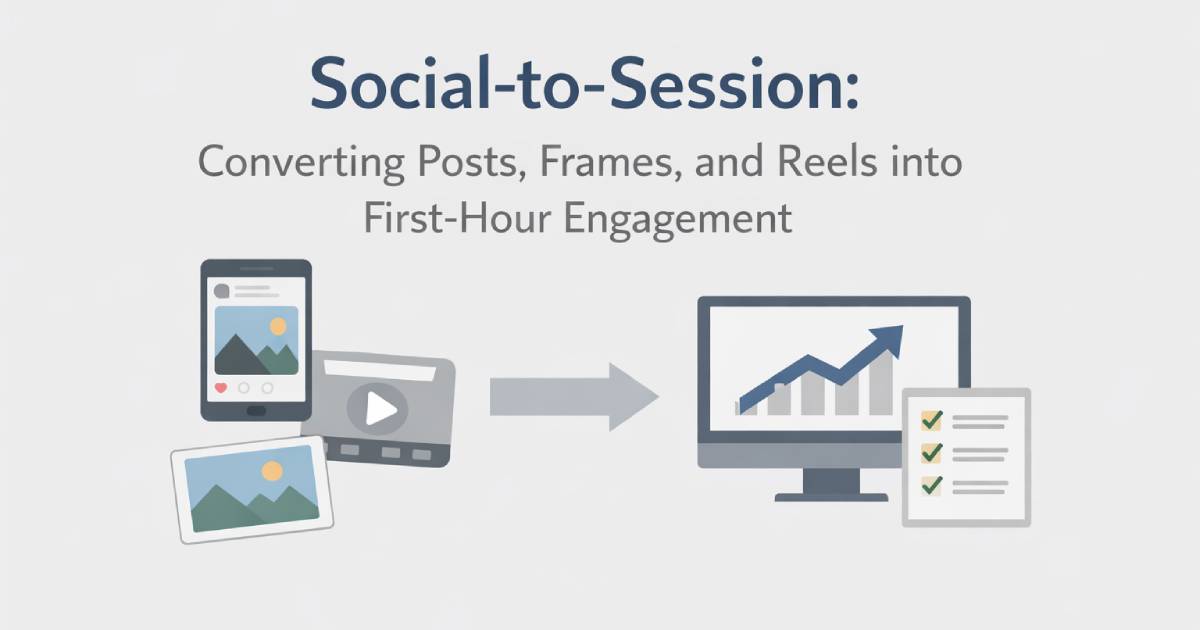
Social-to-Session: Converting Posts, Frames, and Reels into First-Hour Engagement
February 3, 2026 / Orion's Gate Team
f discovery doesn't become a session, it's just vanity. In 2025, the best-performing web3 games wire social surfaces-posts, Farcaster Frames, and short video reels-directly into the first hour: wallet connect, tutorial beat, and a “first win.” This article lays out a practical, KPI-driven plan to turn social reach into sessions, with tools and benchmarks you can cite. Aim for “session, not like.” Treat Reels, posts, and Frames as front doors to a 3-step first-hour flow: join → act → reward. Use the right pipes. Frames (Farcaster) can call actions and track them; deep links route users from social to in-app screens; Discord Server Insights shows where newcomers stall [9][10][11][7][3]. Benchmark ruthlessly. Reels remain a high-impression format for smaller accounts; track D1 quest completion and week-one retention to validate your funnel [1][5].
Why “social-to-session” is a product problem (not just marketing)
Engagement rates on the big socials fluctuate year-to-year, but reach ≠ readiness. Recent benchmark reports show shifting baselines and format dynamics (e.g., Reels delivering outsized impressions for small-mid accounts) [1][2]. Your job is to convert that spike into a wallet connection, a finished tutorial, and an early reward-events that predict retention. Build your social program with those KPIs at the center, not a vanity engagement target.
The conversion architecture
At the surface: format-native CTAs
Farcaster Frames: Use buttons that trigger app/site actions; instrument with Pinata FDK analytics to see taps, drop-offs, and cohort behavior [9][10].
Reels/shorts: Pin a universal deep link in the caption/overlay that resolves to app if installed or Store → specific screen after install (deferred deep link) [7][8].
The bridge: smart routing
Use deferred deep links so newcomers land on the right in-app step post-install (e.g., “Claim Starter Kit” screen). This reduces “lost context” after store hops [7][8].
The destination: first-hour funnel
Step 1: Join (Discord role or wallet connect).
Step 2: Act (finish tutorial quest).
Step 3: Reward (cosmetic, badge, or points).
Track the funnel with Zealy Analytics for quest completion/retention and Discord Server Insights for activation cohorts [5][3][4].
Format-by-format playbook
A) Farcaster Frames → “one-tap actions”
Ship a Join + Claim frame that: (i) verifies wallet, (ii) tags the user, (iii) returns a success state with next step.
Use FDK analytics to A/B the copy (“Claim Starter Kit” vs “Begin Quest 1”) and button order [9][10].
Pipe Frame events into a Dune dashboard (Farcaster data is queryable on Dune via Neynar) for cohort analysis [11][12][13].
Target KPI: ≥55% tap-through on first Frame view; ≥30% complete the follow-up quest within 24h.
B) Reels/Shorts → “watch → play in 60 seconds”
Use a countdown format Reel (“60 seconds to your first harvest/win”).
Overlay a universal/deferred deep link that drops users on a single action screen post-install [7][8].
Benchmark impressions and CTR against industry reports; smaller accounts often see outsized Reels reach-lean into that with frequent tests [1][2].
Target KPI: ≥1.5% Reel → link-click; ≥40% of clickers complete the first quest.
C) Posts/Threads → “micro-quests”
Publish evergreen micro-quests (daily/weekly) that award points or cosmetics; Zealy recurrence makes this trivial [6]. Pair each quest with a short clip or carousel demonstrating the action.
Target KPI: D1 micro-quest completion ≥45%; repeat rate ≥25% by week two.
Measuring first-hour success (dashboards you'll actually use)
Acquisition: Reel/Frame impressions → clicks → app opens (platform analytics + Branch/Adjust deep link reports) [7].
Activation: Quest D1/D7 completion and time-to-first-message (Zealy + Discord Server Insights) [5][3].
Cohorts: Farcaster user cohorts by channel/creator (Dune dashboards) [11][12].
Drop-offs: Click → app store → open → deep-linked screen; fix the biggest leak first with better copy, fewer permissions, or a lighter first task [8].
Templates you can use for a week
Frame CTA: “Start in 60s → Verify wallet → Claim Starter Kit → Begin Quest 1.”
Reel Script: Cold open (3s) → in-engine payoff (5s) → overlay deep link → end-card with social proof.
Discord First-Hour: Auto-DM new members with two buttons: [Link Wallet] (webview) + [Complete Quest 1]; monitor the Growth & Activation section in Server Insights to see if newcomers retain after events [4].
Common pitfalls (and quick fixes)
“Link in bio” purgatory: Without deep links, users lose context after installing. Fix with deferred deep linking to the exact first action [7][8].
All hype, no habit: A pretty Reel with no micro-quest converts poorly. Always ship a paired quest with Zealy and measure completion [5].
Blind spots: If you can't see where people churn, you'll optimize the wrong step. Add Pinata FDK analytics to Frames and enable Discord Server Insights once you cross 500 members [9][3].
Conclusion
Social reach is table stakes; first-hour completion is the win condition. Build format-native CTAs (Frames & Reels), route with deep links, and measure the first 60 minutes like a product funnel. When every post, frame, or reel maps to a quest and a reward, your discovery spikes turn into day-one sessions-and tomorrow's retained players.
References
Socialinsider — Instagram Benchmarks 2025 (engagement + Reels dynamics).
Rival IQ — 2025 Social Media Industry Benchmark Report (cross-network benchmarks & trends).
Discord — Growing Your Community Through Server Insights & Analytics (native analytics overview, available at 500+ members).
Discord — Understanding Server Insights (Growth & Activation cohort views, event impact).
Zealy Docs — Get Started with Zealy Analytics (quest completion, retention, growth).
Zealy Docs — Quest Recurrence (daily/weekly/monthly repeatable quests).
Adjust — Complete Guide to Mobile App Deep Linking (why deep linking boosts conversion).
Branch — In-App Routing & Deferred Deep Links (post-install context preservation).
GitHub — Pinata FDK (Frames + analytics SDK).
YouTube — How to use Farcaster Frame Analytics (Pinata FDK).
Dune — Farcaster Analytics (queryable protocol data).
Dune Docs — Farcaster data via Neynar on Dune (data catalog & access).
Dune Dashboard — Farcaster metrics dashboards/examples.