Industry Insights
Telegram-to-Token: How Mini Apps on TON Became Web3 Gaming's Fastest Distribution Loop
March 3, 2026 / Orion's Gate Team
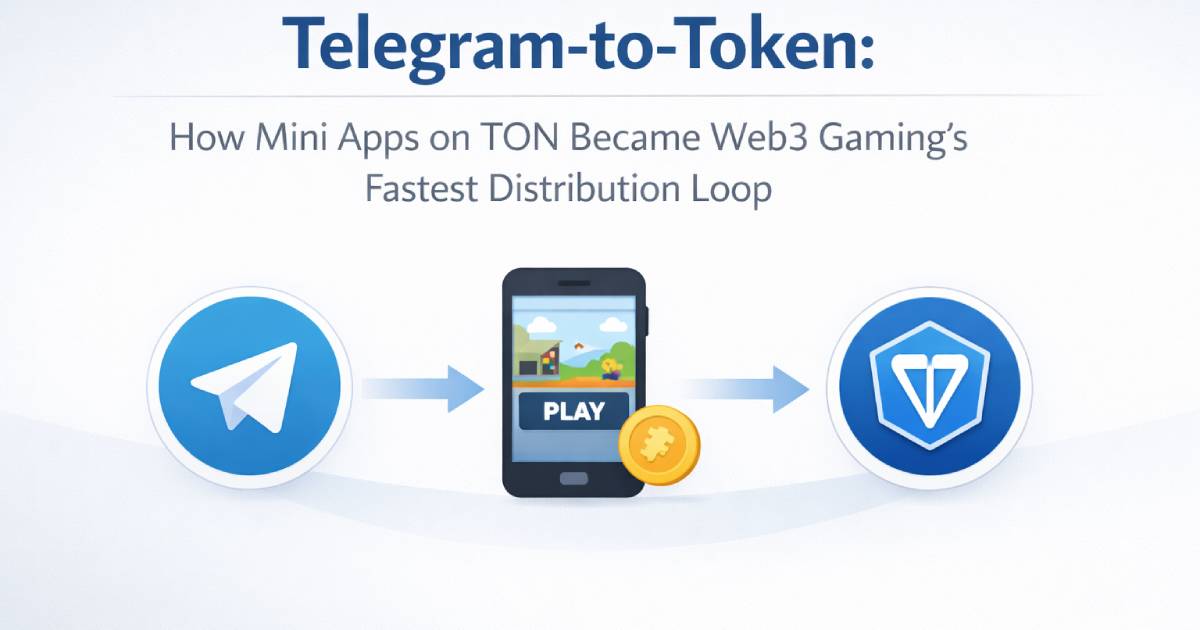
In 2025 and 2026, the most efficient growth engine in Web3 gaming doesn't look like a launcher, a marketplace, or a chain war. It looks like a messenger. Telegram Mini Apps (web apps that run inside Telegram) let games ship into a social graph where users already spend time, already share links, and already join communities. That “distribution-native” environment-plus TON as Telegram's preferred on-chain rail-created a new playbook: chat → tap-to-play → referral loops → token moment → retention. [1][2][3][4][5] This article breaks down what actually made the Telegram-to-token loop work, what broke when hype cooled, and how studios can build a version that lasts beyond airdrops.
Why Telegram Mini Apps changed the funnel
Traditional Web3 funnels are heavy: install a wallet, store seed phrase, bridge funds, approve transactions, then maybe play.
Telegram Mini Apps invert that. They launch instantly inside a chat context and support seamless authorization, push notifications, and payments through Telegram's supported providers (including Apple Pay/Google Pay “out of the box” for supported setups). [1]
Now pair that with Telegram's scale-1B+ monthly active users-and you get something Web3 has always struggled to buy: distribution with built-in social mechanics. [6]
Key shift: the “first session” doesn't start at a wallet. It starts at a message.
The TON advantage: one chain, one connector, one UX
Telegram's ecosystem momentum accelerated when TON became the primary on-chain path for Mini Apps with crypto functionality. TON Foundation announced an expanded partnership positioning TON as the exclusive blockchain for Telegram's Mini App platform and TON Connect as the standard wallet-connection protocol for Mini Apps. [2]
Why that matters for growth:
Less fragmentation for users (fewer confusing chain choices)
Faster product iteration for studios (one integration standard)
Cleaner expectations for wallets, airdrops, and marketplace rails
Whether you love exclusivity or not, the effect is clear: onboarding becomes repeatable. [2][7]
The playbook in the wild: Notcoin and Hamster Kombat
Two titles made the distribution loop impossible to ignore:
Notcoin: the “frictionless first taste”
Notcoin launched as a Telegram Mini App and grew into a massive community before the token moment. When the NOT token went live on TON, the project airdropped 80B+ tokens to participants and cited 35M+ players-a scale that looks like mainstream mobile, not niche crypto. [4][5]
What Notcoin proved: you can postpone “crypto complexity” and still create on-chain scale if the product is native to the social platform first. [5]
Hamster Kombat: viral gameplay + social proof at internet scale
Hamster Kombat became a cultural phenomenon inside Telegram's social loops. Telegram founder Pavel Durov publicly highlighted user growth (hundreds of millions), and major coverage documented how it reached extraordinary scale for a game that lives inside a messenger. [8][9]
What Hamster Kombat proved: Telegram isn't just a channel for communities-it can be a full-blown consumer game platform when mechanics fit the medium. [8]
The “Telegram-to-Token” flywheel explained
Here's the loop that powered the mini-app gaming wave:
Instant entry: user taps a link in a chat/channel and the game loads immediately (no app store friction). [1]
Simple, repeatable action: short sessions with visible progress (tap, upgrade, claim, invite).
Referral mechanics that feel native: users share directly in Telegram where they already coordinate and compete.
Token anticipation: points/levels create a “future value” narrative (airdrop, mint, unlock). [5]
Token moment: trading, claiming, or converting creates a second spike of attention. [4][5]
Retention fork: either you have real gameplay + sinks + community loops… or the audience churns after the token event.
That last step is where most projects succeed or fail.
What studios should copy (and what to avoid)
What to copy: “web2 onboarding, web3 depth later”
Design the first 10 minutes to feel like a normal mobile game:
No wallet required to start
One-tap account creation tied to Telegram identity/session
A clear objective loop with daily hooks (streaks, quests, social tasks)
Telegram Mini Apps support the UX primitives to do this (auth, notifications, payments), so your job is to use them like a consumer product studio would. [1]
What to avoid: airdrop-only gameplay
Coverage and ecosystem commentary in 2024-2025 made a pattern obvious: many mini-games were airdrop-first, meaning retention collapsed when the token narrative ended. [10]
If your core loop is “do chores to maybe get a token,” you're renting attention.
A durable Mini App economy blueprint
If you're building an industry-ready Telegram Mini App in 2026, aim for a “three-layer” economy:
Layer 1: Skill and progression (off-chain feel)
Levels, upgrades, cosmetics, crafting
Social competition (leaderboards, clans, raids)
Layer 2: Ownership with guardrails (on-chain utility)
Minted cosmetics/items only after players show intent (e.g., D3 retention milestone)
Limited issuance tied to seasonal content
Clear sinks (crafting consumes items, upgrades burn resources)
Layer 3: Monetization that doesn't depend on speculation
Telegram-compatible payments for boosters/season passes where appropriate [1]
Marketplace fees that are secondary to gameplay, not the game itself
This structure protects you from the post-airdrop cliff while still giving Web3 its signature value: portable ownership and player-driven markets.
The metrics that matter for Telegram-native growth
To make this an “industry insights” win (and not another hype wave), track:
Click → first action (TTA): time to first meaningful interaction (target: under 20 seconds)
K-factor (referral): invites per active user per day
D1/D7 retention: prove it survives beyond token speculation
Conversion to wallet connect: connect when it's needed, not immediately
Post-token retention delta: retention change before/after token event (the truth test)
If your post-token retention doesn't hold, the product is a campaign-not a game.
What comes next: Mini Apps as the “social layer” of Web3 gaming
Telegram Mini Apps demonstrated something the wider industry underestimated: distribution is a feature. When your game runs where the community already lives, growth mechanics become product mechanics.
The next wave won't be “bigger airdrops.” It'll be teams that build:
Real midcore loops inside Mini Apps
Sustainable economies with sinks and seasonal content
On-chain depth that activates after players are already invested
That's how Telegram-to-token becomes Telegram-to-tenure.
References
[1] Telegram Core Docs — “Telegram Mini Apps (Bots Web Apps)” (auth, payments, notifications).
[2] TON Foundation (PRNewswire) — TON becomes the exclusive blockchain for Telegram Mini Apps; TON Connect standardization (Jan 21, 2025).
[3] Cointelegraph — TON exclusivity / Telegram Mini Apps infrastructure context (Jan 2025).
[4] The Block — Notcoin token goes live on TON; airdrops 80B+ NOT tokens (May 2024).
[5] The Block — Notcoin grew to 35M+ players; Telegram Mini App origins (May 2024).
[6] TechCrunch — Telegram founder says Telegram has 1B active users (Mar 19, 2025).
[7] Cointelegraph — Hamster Kombat scale and TON mint narrative from Durov (context for Web3 onboarding).
[8] WIRED — “How Telegram Game Hamster Kombat Got 300 Million Users…” (2024).
[9] Cointelegraph — Hamster Kombat hitting 239M users in 81 days (reported via Durov statements, 2024).
[10] Game World Observer — Telegram Mini Apps platform features + monetization patterns and ecosystem insights (Apr 2025).