
Technology
The Hybrid Stack: What Runs on Web2 and What Belongs on the Blockchain?
July 21, 2026 / Orion's Gate Team
When blockchain gaming first emerged, many enthusiasts imagined a future where every aspect of a game-from player movement to combat and item ownership-would live entirely on the blockchain. It was an exciting vision that promised transparency, decentralization, and true digital ownership. Reality, however, has proven more nuanced.
Why the Future of Web3 Gaming Isn't Fully On-Chain
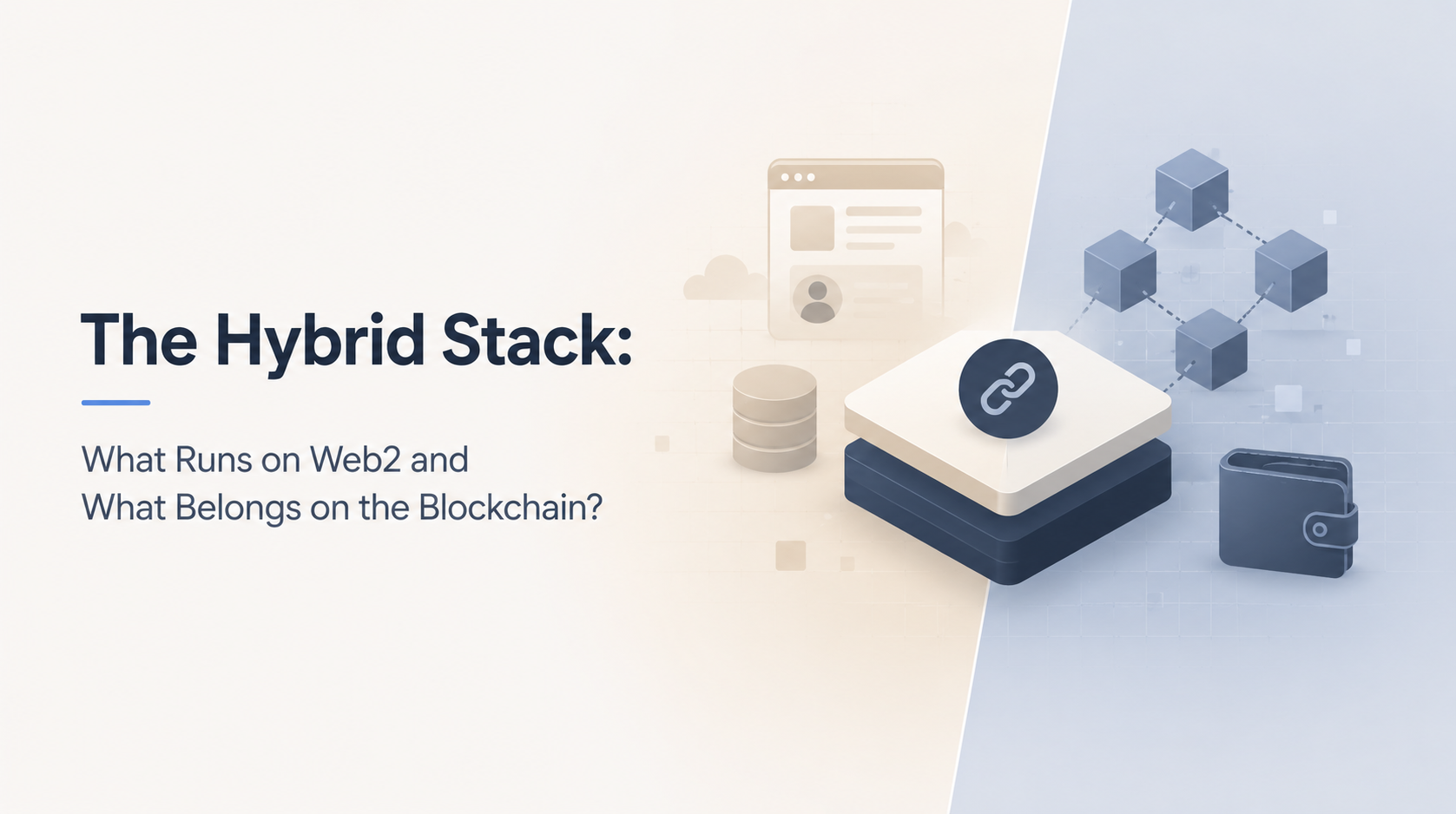
As Web3 gaming matures, developers are increasingly embracing hybrid architectures that combine traditional Web2 infrastructure with blockchain technology. Rather than replacing existing game servers, blockchain is becoming one component of a larger technology stack, responsible for the features that benefit most from decentralization while leaving performance-critical systems to conventional infrastructure.
The result is a better player experience, improved scalability, and games that are both technically practical and commercially viable.
Why Fully On-Chain Games Face Technical Limits
Public blockchains excel at providing security, transparency, and immutable ownership. However, they were never designed to process the thousands of real-time interactions that modern online games require.
Consider a multiplayer action game. Every second, servers must process:
Character movement
Combat calculations
Physics simulations
AI behaviors
Matchmaking
Voice and text chat
Environmental updates
Executing every one of these actions on-chain would introduce unacceptable latency and dramatically increase transaction costs. Even with Layer-2 networks offering significantly higher throughput than traditional Layer-1 blockchains, fully on-chain gameplay remains impractical for most real-time games [1].
Instead of forcing blockchain to solve problems it wasn't built for, modern studios are designing systems that leverage the strengths of both technologies.
The Hybrid Stack Explained
A hybrid Web2 + Web3 architecture divides responsibilities between centralized servers and blockchain networks.
Think of it as assigning each technology the tasks it performs best.
Web2 Handles Speed
Traditional cloud infrastructure powers systems where speed and responsiveness are critical.
These typically include:
Player authentication
Matchmaking
Multiplayer networking
Character movement
Combat logic
Physics
Chat systems
Notifications
Analytics
Anti-cheat detection
Leaderboards
Live events
These services often rely on technologies such as Kubernetes, Redis, PostgreSQL, WebSockets, Kafka, and cloud providers like AWS, Google Cloud, or Azure.
Latency is measured in milliseconds, allowing games to feel responsive regardless of player location.
Web3 Handles Trust
Blockchain excels whenever ownership, transparency, and verification matter more than raw speed.
Common blockchain responsibilities include:
Digital asset ownership
NFTs
Marketplace transactions
Token economies
Crafting verification
Digital identity
Reputation systems
Governance
Reward distribution
Cross-game assets
Unlike traditional databases, blockchain allows players-not developers-to verifiably own digital items while maintaining transparent transaction histories [2].
The Best Example: Inventory Systems
Inventory management perfectly illustrates why hybrid design works.
Imagine a player acquiring a legendary weapon.
The game server immediately updates the player's inventory so gameplay continues without interruption.
Later, the blockchain records permanent ownership of that item as an NFT or another on-chain asset.
If the player wants to trade, sell, or transfer the weapon, blockchain verifies ownership.
If the player simply wants to equip it during combat, the centralized game server handles everything instantly.
Players enjoy fast gameplay while still benefiting from decentralized ownership.
Why Gameplay Should Stay Off-Chain
Real-time gameplay demands instant responses.
Imagine waiting three seconds every time you jump, attack, or open a treasure chest because the action must be confirmed on-chain.
The experience would quickly become frustrating.
This is why most successful blockchain games treat the blockchain as a settlement layer rather than an execution layer.
Gameplay happens off-chain.
Ownership settles on-chain.
This separation enables developers to deliver experiences that feel just as smooth as traditional online games while preserving the unique advantages of Web3.
Synchronizing Two Worlds
Running both Web2 and Web3 systems introduces a new engineering challenge: synchronization.
Every time an important event occurs-crafting an item, completing a quest, purchasing equipment-the game must ensure that both the centralized database and blockchain remain consistent.
Developers typically solve this using event-driven architectures.
When an action occurs:
The game server processes the action.
An event is published.
Blockchain services validate the transaction.
Indexers monitor blockchain confirmations.
Databases update once the transaction is finalized.
Technologies such as event queues, blockchain listeners, and indexing services have become essential components of modern hybrid game backends [3].
Without reliable synchronization, players could experience duplicated assets, inconsistent inventories, or failed transactions.
Why Hybrid Login Matters
Authentication is another area where hybrid architecture shines.
Most mainstream players expect to log in using:
Google
Apple
Steam
Discord
Email
Asking new players to create wallets, manage seed phrases, and purchase cryptocurrency before entering a game dramatically increases onboarding friction.
Modern Web3 infrastructure addresses this through embedded wallets and account abstraction.
Players authenticate using familiar Web2 methods while blockchain wallets are created and managed behind the scenes.
To the player, it feels identical to logging into any online game.
Underneath, blockchain infrastructure securely manages digital ownership [4].
Security Requires Both Worlds
Blockchain provides tamper-resistant ownership records, but it cannot replace traditional cybersecurity.
Hybrid games still require:
Fraud detection
Anti-cheat systems
Bot prevention
DDoS protection
Rate limiting
Secure APIs
Database security
Likewise, blockchain adds protections that centralized systems cannot provide, including immutable ownership records and transparent economic transactions.
The strongest security model combines both approaches rather than relying exclusively on either one.
The Future Is Not Web2 or Web3-It's Both
The industry's direction is becoming increasingly clear.
Rather than asking whether games should be Web2 or Web3, developers are asking a more practical question:
Which technology is best suited for each problem?
Player movement belongs on fast servers.
Asset ownership belongs on the blockchain.
Chat belongs in centralized infrastructure.
Marketplace transactions belong on-chain.
Game logic belongs where it performs best.
Ownership belongs where players can trust it.
This philosophy is already shaping the architecture of leading blockchain gaming platforms and is likely to become the industry standard over the next decade.
Conclusion
The future of Web3 gaming will not be defined by putting everything on-chain.
Instead, it will be defined by intelligent hybrid architectures that combine the performance of Web2 with the trust and ownership offered by blockchain.
Players won't care whether a feature runs on a cloud server or a decentralized network.
They'll care that the game is fast, secure, fair, and fun.
For developers, that's the real lesson of the hybrid stack: use blockchain where it creates value, and use traditional infrastructure where it delivers the best player experience.
The most successful games of the future won't choose between Web2 and Web3.
They'll combine the strengths of both.
References
[1] Ethereum Foundation. Layer 2 Scaling Overview. https://ethereum.org/
[2] Ethereum Foundation. ERC-721 Non-Fungible Token Standard.
[3] The Graph Foundation. Indexing Blockchain Data for Decentralized Applications.
[4] ERC-4337 Documentation. Account Abstraction on Ethereum. https://docs.erc4337.io/