
Community
The Post-Hype Era of Web3 Gaming: What Survives After the Buzz Is Gone
May 18, 2026 / Orion's Gate Team
Web3 gaming is no longer in its “everything on-chain, everything tokenized” phase. The hype wave has cooled, NFT trading had a weak 2024 by DappRadar's count, and Web3 gaming activity and funding both softened in early 2025. At the same time, the sector has not disappeared. What remains is more practical, more selective, and far more focused on player experience than speculation. That shift matters because it changes the question. The old question was, “How do we make everything Web3?” The new one is, “Which parts of Web3 actually make games better?” In the post-hype era, the projects that survive are not the loudest. They are the ones that keep utility, reduce friction, and protect trust.
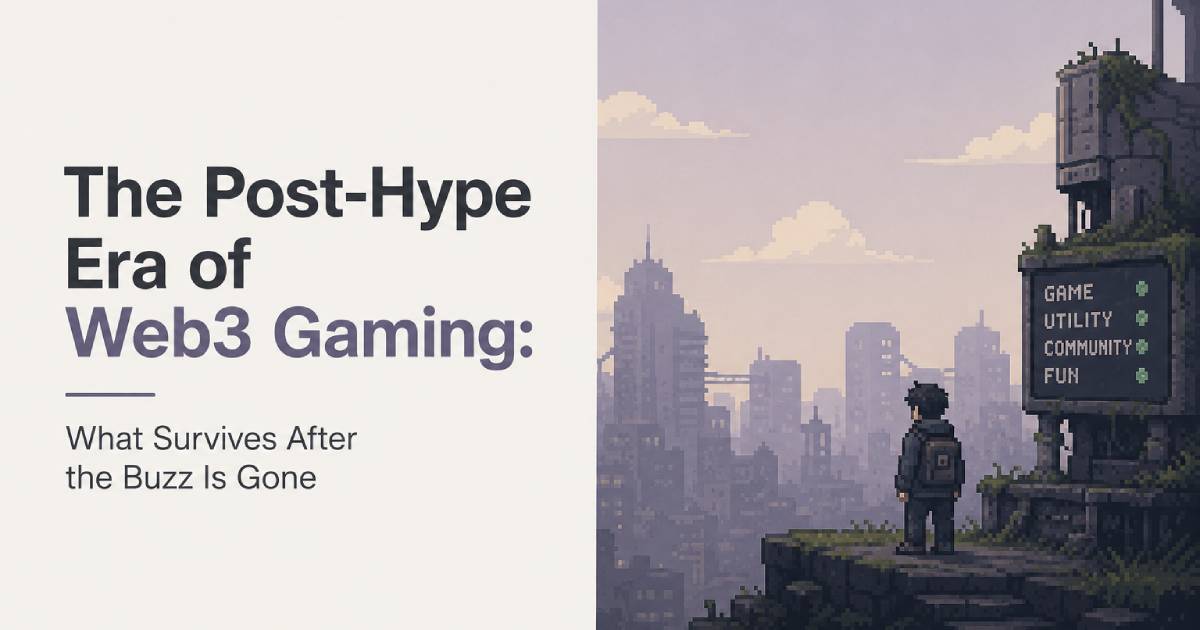
The hype is gone, but the useful parts remain
The cooling is real. DappRadar's 2024 overview says NFT trading volumes fell 19% year over year and sales counts fell 18%, making 2024 one of the weakest NFT years since 2020. Its Q1 2025 blockchain gaming report adds that gaming reached 5.8 million daily unique active wallets, down 6% quarter over quarter, while Web3 gaming investment totaled $91 million, down 71% QoQ even as deal count rose 35%. That is not a “death of the sector” story. It is a filtering process.
What gets filtered out first is speculation-first design. In the boom years, many projects sold the promise of ownership before proving why the game itself deserved a community. In the post-hype era, players are less interested in token language and more interested in whether the game is fun, social, and easy to access. That is why the surviving layer of Web3 gaming increasingly looks like infrastructure, not ideology.
What actually survives
1) Better onboarding
One of the clearest survivors is wallet infrastructure that feels closer to Web2. Immutable's Passport is a strong example: players can sign in with Google, Apple, or email, get a wallet automatically, and avoid extensions, seed phrases, and extra downloads. That is a major departure from the old expectation that users should “learn crypto” before they can play.
This broader shift is supported by account abstraction as well. ERC-4337 exists specifically to make wallet behavior more programmable and user-friendly without changing Ethereum's base consensus layer. In practice, this is part of why gas sponsorship, embedded wallets, and smoother account UX have become central to modern Web3 onboarding.
2) Hybrid distribution
Another survivor is the hybrid model: Web2 access, Web3 utility. Google Play's policy update explicitly opened the door to blockchain-based digital content in apps and games, but paired that with requirements around transparency and user protection. That is a strong signal about where the market is going: not toward pure crypto-native isolation, but toward platform-compliant, mainstream-friendly implementations.
The opposite example is also instructive. Valve's Steam policy banned games that issue or allow the exchange of cryptocurrencies or NFTs. That move helped define the limits of mainstream distribution for pure blockchain-first game models. In other words, what survives is not “Web3 instead of Web2,” but Web3 that can live inside Web2 realities.
3) Ownership with a reason to exist
The post-hype market is less willing to reward ownership as a gimmick. What survives is ownership tied to identity, progression, collectibles with real in-game relevance, or community status. DappRadar's 2024 report even notes that NFTs had a weak financial year while still retaining importance in the broader ecosystem. That is a useful distinction: the speculative layer may cool, while the utility layer remains.
This is also visible outside games. The rise and fall of OpenSea and the closure of RTFKT both show that attention alone is not enough to sustain a Web3 product long term. Community, culture, and digital ownership can still matter, but they have to be attached to a stronger product loop than market hype.
4) Community systems that feel normal
The strongest Web3 gaming communities in this era are not the ones shouting about decentralization every day. They are the ones making participation easy. That means communities built around gameplay, creator culture, guilds, and social identity first, then using wallets, token-gated roles, or on-chain rewards only where those tools add meaning. Google Play's emphasis on safe, transparent experiences reflects the same market logic: trust now matters as much as innovation.
What dies off
What fades in the post-hype era is familiar by now: complicated wallet setup, token-first onboarding, marketplaces with no gameplay value, and product messaging that sounds like an investment thesis instead of a game pitch. Even DappRadar's 2024 report suggests gaming activity may be moving more off-chain, which supports the idea that seamless experience matters more than ideological purity.
The projects that struggle most are often the ones that confuse visibility for retention. Buzz can attract a wallet. It does not automatically build a player base. Once the speculative upside disappears, only the games with better onboarding, better loops, and better communities keep people around.
The real future: quieter, stronger, more hybrid
The future of Web3 gaming probably looks less like a revolution and more like a merge. Web2 will continue to dominate discovery, app distribution, and familiar account systems. Web3 will survive where it can quietly improve ownership, identity, community rewards, and interoperability. The result is not a retreat. It is a more realistic design philosophy.
That is what survives after the buzz is gone: frictionless wallets, selective on-chain utility, platform-aware publishing, and communities that care more about belonging than speculation. In the post-hype era, Web3 gaming does not win by being louder. It wins by being less visible and more useful.
References
DappRadar — Dapp Industry Report – 2024 Overview.
DappRadar — State of Blockchain Gaming in Q1 2025.
Immutable — Passport Documentation Overview.
Android Developers Blog — Enabling New Blockchain-Based Experiences on Google Play.
Game Developer — Valve bans cryptocurrency games and NFTs from Steam.
Ethereum Improvement Proposals — ERC-4337: Account Abstraction Using Alt Mempool.
arXiv — Account Abstraction, Analysed.
Vogue Business — RTFKT — an early Web3 fashion success story — is folding.
The Verge — The rise and fall of OpenSea.