Technology
Why Most Web3 Games Will Look Like Web2 Games by 2030
June 9, 2026 / Orion's Gate Team
As blockchain gaming matures, the most successful Web3 games may become almost indistinguishable from traditional Web2 games. This article explores how technologies such as account abstraction, embedded wallets, gasless transactions, and hybrid blockchain architectures are removing friction from the player experience. It examines why future gamers will likely enjoy the benefits of digital ownership, decentralized economies, and blockchain-based assets without ever needing to understand wallets, gas fees, or NFTs. Ultimately, the future of Web3 gaming may not be about making blockchain more visible-it may be about making it disappear.
The Future of Web3 Gaming May Look Surprisingly Familiar
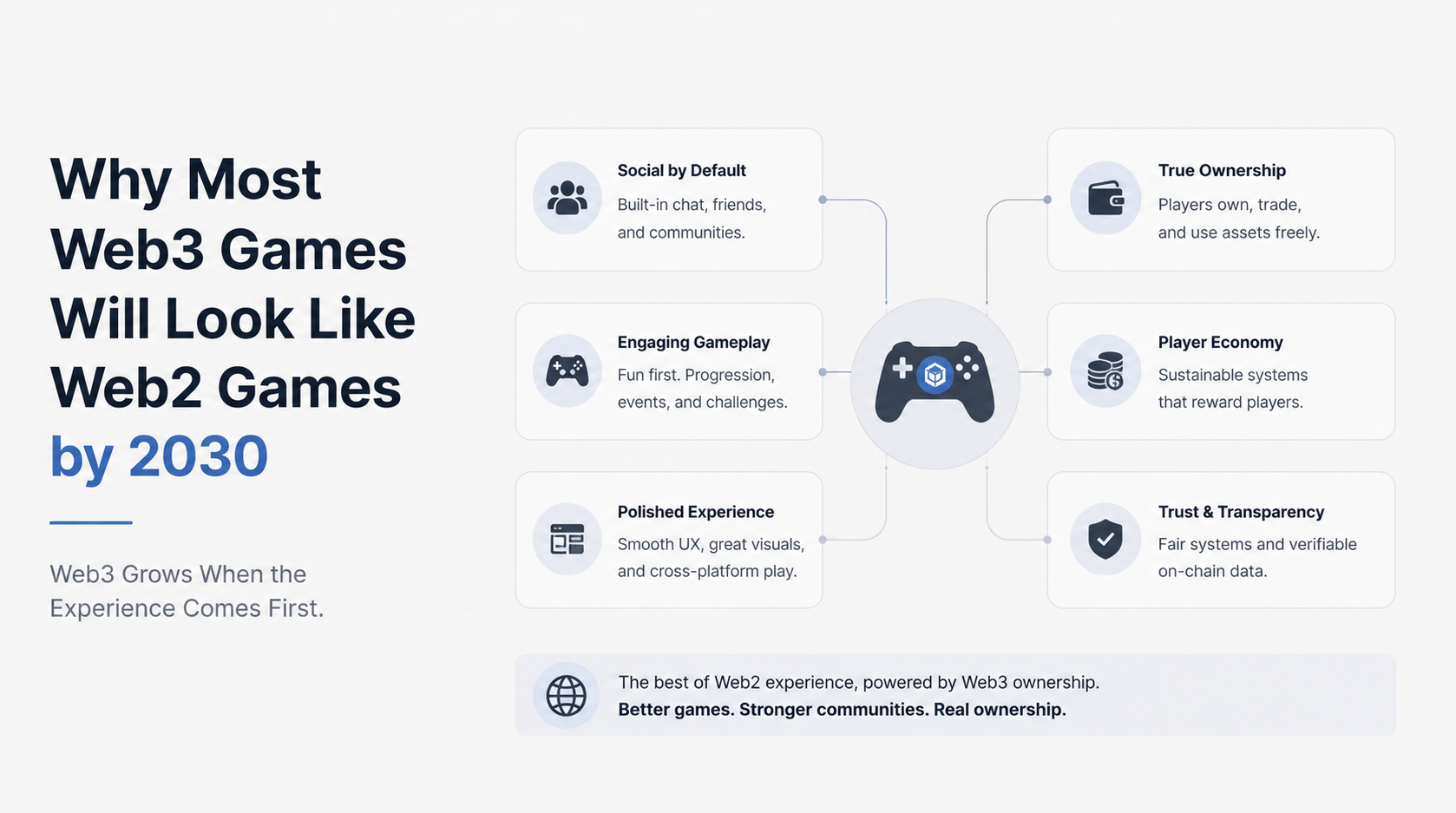
When people imagine Web3 games, they often picture visible wallets, NFT marketplaces, token rewards, and blockchain dashboards. But by 2030, the most successful Web3 games may not look “Web3” at all.
Instead, they will likely look and feel much more like traditional Web2 games: fast onboarding, smooth gameplay, familiar accounts, invisible payments, and polished user interfaces.
The difference will be hidden underneath the surface.
Players may still own assets, trade items, access blockchain-powered economies, and carry persistent digital identities. But they may not need to think about wallets, gas fees, seed phrases, or chains. This shift is already beginning through technologies like account abstraction, embedded wallets, and gaming-focused blockchain infrastructure [1][2].
Why Current Web3 Games Feel Too Complicated
The biggest problem with many Web3 games is not the technology itself. It is how visible the technology is.
Players are often asked to:
Create a wallet
Store a seed phrase
Buy tokens
Pay gas fees
Bridge assets
Understand blockchain networks
For crypto-native users, this may feel normal. For mainstream gamers, it feels like friction.
Traditional games became successful because they removed complexity from the player experience. Players open the game, create an account, customize a character, and start playing. Web3 games must reach the same level of simplicity if they want mass adoption.
That is why the next phase of Web3 gaming will not be about showing blockchain features more clearly. It will be about hiding them better.
Account Abstraction Will Make Wallets Feel Like Game Accounts
One of the biggest technologies pushing Web3 games toward a Web2-like experience is account abstraction.
Account abstraction allows smart contract wallets to behave more flexibly than traditional crypto wallets. With standards such as ERC-4337, developers can create wallet experiences that support features like gas sponsorship, programmable security, and simplified authentication without changing Ethereum's core protocol [1][3].
For games, this matters because it enables:
Social login
Passwordless onboarding
Gasless transactions
Account recovery
In-game wallets hidden behind normal player accounts
In other words, the player does not need to understand the wallet. The wallet becomes part of the game account.
By 2030, many players may be using blockchain wallets without realizing it, just as today many users rely on cloud saves, payment processors, and matchmaking servers without thinking about the backend technology.
Web3 Games Will Focus on Gameplay First
Early blockchain games often led with financial incentives: earn tokens, trade NFTs, speculate on assets. This helped attract attention, but it also created a major problem. Many games were judged more like investment platforms than entertainment products.
By 2030, the winning Web3 games will likely reverse this order.
The game must come first. Blockchain should support the experience, not define it.
Players will care about:
Is the combat fun?
Is the world interesting?
Are the characters memorable?
Is the progression rewarding?
Can I play with friends easily?
Only after that will ownership, trading, and tokenized assets matter.
This is why future Web3 games may look like Web2 games on the surface. Developers will design familiar interfaces, traditional progression systems, and polished gameplay loops while placing blockchain systems quietly in the background.
Digital Ownership Will Become Invisible Infrastructure
The strongest long-term promise of Web3 gaming is digital ownership. Players can own skins, land, characters, weapons, or collectibles in a way that is not fully controlled by a central publisher.
But ownership does not need to be loud.
Most players do not want to think about token standards or smart contracts. They want to know that the item they earned is theirs, that it can be traded safely, and that it has value inside the game ecosystem.
Platforms such as Immutable Passport are already moving in this direction by combining familiar login systems with Web3-native features for gaming, including account creation, signing, trading, inventory, and on-chain interactions [2].
By 2030, “owning an NFT” may not be the headline. The player may simply see a rare sword, a unique avatar, or a limited-edition skin inside a normal game inventory.
The blockchain layer will verify ownership. The interface will feel familiar.
The Best Blockchain Games Will Hide the Chain
Another reason Web3 games will look like Web2 games is performance.
Fast-paced games cannot wait for every action to settle on-chain. Movement, combat, matchmaking, physics, and real-time multiplayer systems still require low-latency infrastructure.
That means most Web3 games will continue using hybrid architecture:
Off-chain systems for gameplay
On-chain systems for ownership, trading, identity, and economy
This model gives developers the best of both worlds: Web2-level performance with Web3-level asset ownership.
By 2030, blockchain may function more like a settlement layer than a visible gameplay layer. Players will fight, craft, explore, and trade through smooth interfaces, while the chain handles asset verification and economic history behind the scenes.
Regulation and App Stores Will Push Web3 Toward Familiar UX
There is also a business reason Web3 games will become more Web2-like: distribution.
To reach mainstream players, games need access to platforms such as mobile app stores, PC launchers, and console ecosystems. These platforms usually prefer clear payment flows, consumer protection, and familiar account systems.
If Web3 games want broad distribution, they will need to reduce friction and avoid overwhelming players with crypto terminology.
That means:
Less “connect wallet”
More “sign in”
Less “pay gas”
More “confirm purchase”
Less “mint NFT”
More “claim item”
The underlying technology may still be blockchain-based, but the language and experience will become more familiar.
Web3 Monetization Will Become More Like Normal Game Economies
By 2030, Web3 monetization may also move closer to traditional game design.
Instead of focusing heavily on speculative token rewards, stronger Web3 games will likely use blockchain for:
Player-to-player trading
Limited digital collectibles
Creator marketplaces
Transparent item scarcity
Community-owned assets
Cross-platform identity
This does not mean tokens will disappear. It means they will become part of a broader economy rather than the main reason people play.
The industry is already learning that sustainable Web3 gaming depends on long-term engagement, not short-term earning models. Blockchain gaming remains one of the most active Web3 categories, but reports also show that the sector still faces adoption and retention challenges [4].
The solution is not more crypto complexity. It is better games.
The 2030 Web3 Game: Familiar on the Surface, Different Underneath
A successful Web3 game in 2030 may look something like this:
A player downloads the game from a normal store. They sign in with email, Apple, Google, or a game account. A wallet is automatically created in the background. The player never sees a seed phrase. Gas fees are sponsored or abstracted. Items appear in a familiar inventory. Trading happens through a simple marketplace. Rare items are blockchain-verified, but the player does not need to know the technical details.
From the player's perspective, it feels like a polished Web2 game.
From the infrastructure perspective, it is Web3.
That is the future: not blockchain everywhere, but blockchain where it matters.
Conclusion: Web3 Gaming Wins When Players Stop Noticing Web3
By 2030, most successful Web3 games will likely look like Web2 games because mainstream players do not want complexity. They want fun, speed, trust, and convenience.
The Web3 layer will still matter. It will power ownership, trading, identity, scarcity, and community economies. But it will become invisible infrastructure rather than the main user experience.
The next era of blockchain gaming will not be won by the games that shout “Web3” the loudest.
It will be won by the games that feel effortless to play.
The future of Web3 gaming may not look like crypto.
It may simply look like gaming.
References
ERC-4337 Documentation — “ERC-4337 Overview and Account Abstraction Standard.”
Immutable — “Immutable Passport,” gaming-focused wallet and authentication infrastructure.
Ethereum.org — “Account Abstraction,” Ethereum roadmap documentation.
DappRadar — “State of Blockchain Gaming Q3 2025.”